Marianne Cauvard and
Raphaël Pluvinage, two students of France’s L’Ensci Les Ateliers, created a
game called Noisy Jelly for a class project in February 2012. The working
prototype is a wooden box containing agar agar, dyes, gelatin molds, and a game
board. Players mix the agar agar with water to create a simple gelatin in a
mold, then add dyes to create the desired color. After ten minutes, the gelatin
shape can be removed from the mold and placed on the game board. Any time
someone touches the gelatin shape on the board, a sound will be emitted. The
board is a capacitive sensor, so any variations will change the sound. Each of
the following help to create a unique sound for each piece: the density of salt
in the gelatin, the shape of the gelatin, the coloring, the pressure posed on
the gelatin, and the location of where the gelatin is touched. Noisy Jelly uses
Arduino and Max/msp. There are no current indications on whether Noisy Jelly
will be mass produced for public consumption.
GingerSnap!'s first cake sold
photo by Steph Koehnen
This is a name you should
remember for the future. GingerSnap! Bakery is the brainchild of bakers Lauren
Strohm and Steph Koehnen. They hope to open GingerSnap! as an online order
bakery within the next five years and have a storefront in under 10. Currently,
the girls bake separately because of locational differences and are not hired
for many events. However both will take orders if asked nicely. The storefront
will likely be designed by recent Coe College graduate Aaron Dayton at an
undecided location in the Midwest.
By Steph Koehnen
GingerSnap! was bred out
of a love of unique flavors. Steph perfects the recipes and makes sure
everything tastes good and Lauren is in charge of the decorations and making
things look pretty. Signature flavors include mint chocolate, orange soda,
apple strussel, and hot fudge sundae. Once they are of age, the menu will
expand to include cocktail-inspired cakes.They will build recipes inspired by a customer's favorite
flavors if requested. Remember the name GingerSnap! and keep an eye out for it within
the next few years.
Horror movies are a
staple of our film industry. Sadly, they are in short supply—many of the recent
horror movies released in the past few years are remakes. Some fairly recent
remakes include Nightmare on Elm Street
(1984, 2010), Friday the 13th
(1980, 2009), My Bloody Valentine
(1981, 2009), The Crazies (1973,
2010), and Halloween (1978, 2007),
among many others. Not only do these remakes exhibit the complete lack of
originality in the horror film industry, they are entirely unnecessary. My Bloody Valentine is perhaps one of
the worst offenders because they change the killer. YOU DO NOT EVER
CHANGE THE KILLER!! (It is in the horror movie commandments, look it up.) For an
original, unexpected horror movie, watch Cabinin the Woods (2012).
There are certain rules
one must abide by to survive a horror movie (this mostly applies to slasher
films—supernatural horror films don’t necessarily work like this). Watch the
video now. It’s the rules from the Scream
Trilogy.
In addition to these, you
never say "Who's there?" or open the door when someone knocks or call out when no one’s there if you
stupidly do open the door. Never run up the stairs in a chase—only stupid people do this for
there is nowhere to go but out the window. Never go looking for the killer.
Never split up. Always double-tap—the killer isn’t truly dead unless you shoot
him in the head or some similar fatal killing. The best weapons are those you
don’t need to reload (this is true in zombie movies, too). And if you’re blonde
and/or have big boobs, you must be
hyperaware of the rules and your surroundings—you’re the most likely to die.
Well so long, I’m screwed.
So this is a little late. My group's project was on film, and we wanted to show this but didn't have time during our presentation. In German 4 in high school, I made a stop-motion silent film (with the titles in German, of course). It is a fun process, but a pain in the ass when you happen to be the only one with a good camera and editing software. It took about 512-515 pictures to complete--I do not remember the exact number. Translations are under the video. I did not write the titles and cannot remember the proper way to translate them, so they do not entirely make sense, but the story should be clear enough despite this.
Der Gnom des Entsetzen: The Gnome of Terror (or Horror)!
Es war einen schoenen Tag. melanie, Georg, und Katja waren sehr froeh in ihren Deutschen Klasse. Alles waren in Gruenen Bereich!: Itwasa nice day. Melanie,George,andKatyawere very happy in theirGermanclass. Everything was good!
Ach! Ein Geschenk!: Oh a present!
Lief weg!!: Run away!!
Georg nahm einen grossen Hauch. Vielleicht hat er sehr schnell weg gelaufen. Warscheinlich der Gnom war ihm treiben.: George took a big breath. Maybe he had run away quickly. The gnom probably followed him.
Melanie und Katja trauerten fuer Georg. Der schlechte Gnom nahm ihn doch sofort. Sie wollten der Gnom fangen!:Melanieand KatiamournedforGeorge.The evilgnometook him immediately.They wanted tofind the gnome!
Geh weg!: Go away!
Der Gnom konnte nicht mehr die Schule terrorisieren. Ein Schatten fiel ueber die Schule. Der Gnom war eine Raeuberhorde, denn er hat vier leben genommen. Wieder kam die Freude, aber Chanhassen war eine Ueberraschung kriegen.: The gnomecouldno longerterrorize theschool.A shadowfellovertheschool.The gnomewas a robber, because hehastakenfour lifes. Again camethe joy, butChanhassenwasgettinga surprise.
Starring:
Shawni Jones as Melanie
George Le as Georg
Caitlyn Fahrenkamp as Katja
Robin as Robin (I don't remember his last name)
and Sarah Bast as Dead Girl #1
Despite being widely
unknown and unrecognized, Whedon and many of his works have received cult status.
Firefly was only produced for 14
episodes with the movie Serenity made
as a follow-up, yet fans (called “Browncoats”) stay wholly dedicated. In 2011,
an internet campaign called Help Nathan Buy Firefly was started after Firefly star Nathan Fillion stated in an
interview with Entertainment Weekly that if he won $300 million from the
California lottery, he would use it to produce more episodes. The idea was for
fans to donate money to help bring the beloved show back. In just one day, over
$10,000 was pledged by fans. After a couple weeks Whedon announced he was not
interested in Help Nathan Buy Firefly because he thought it would not work out
and would be too hard to manage. Browncoats still hope for a revival. Buffy and Angel are also considered of the cult status, but do not have
fan-backing for more episodes because they both aired for many seasons. Many fans of any
or all of these shows and movies proclaim that anything Whedon works on must be
good because he is such a talented man; he has yet to disappoint them.
Whedon helps with "Can't Stop the Serenity," which shows Serenity in theaters to benefit the charity Equality Now. Many of the Serenity cast and crew help with the charity as well. He also participates in Dark Horse Comics, producing a comic in the far future of the world of Buffy called Fray. Most of Whedon's current focus is on online projects.
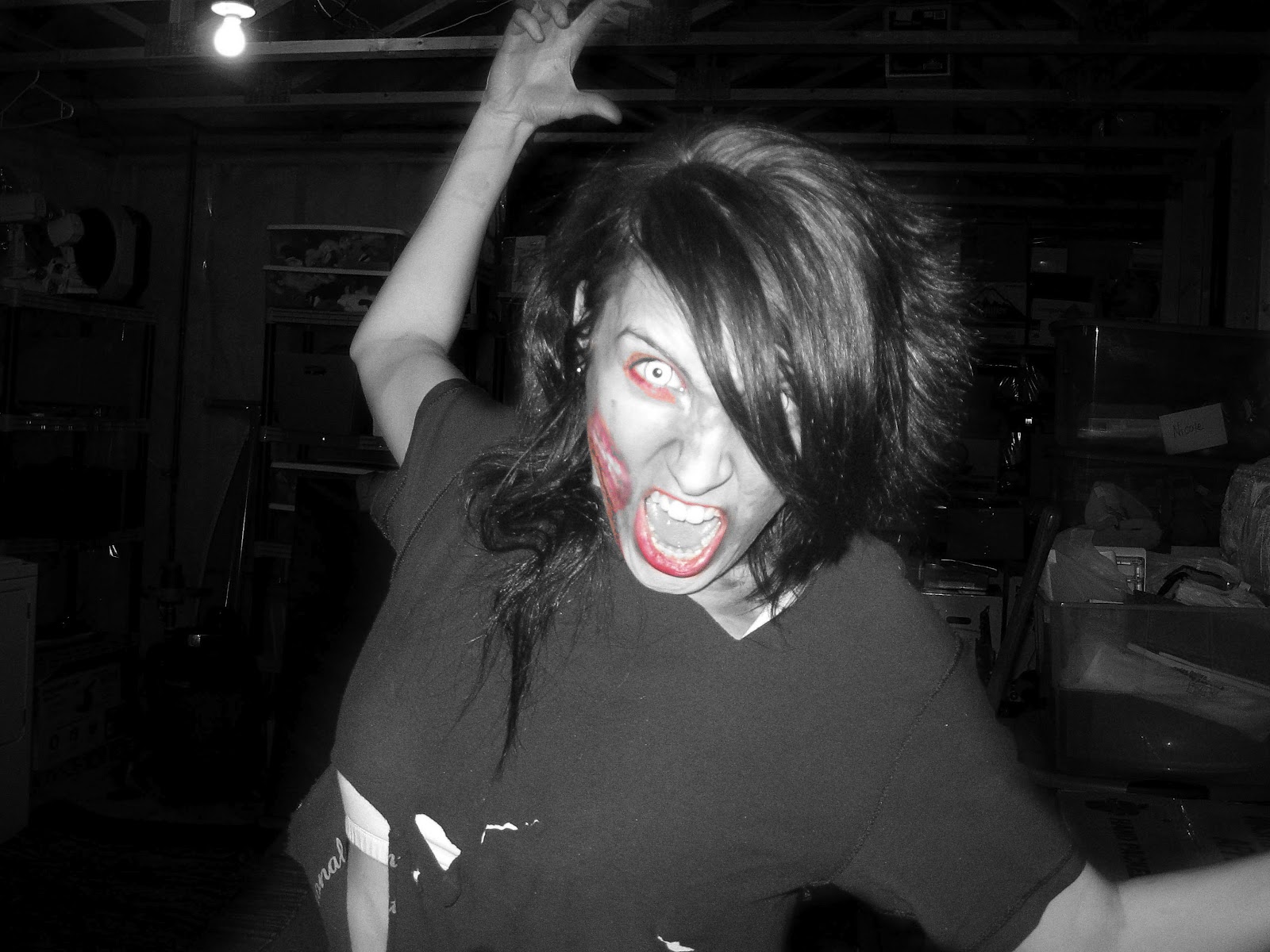
Selective color-A color photograph turned black and white except for
the red tones on the face. (Hand coloring image coming soon)
There are two basic ways
of mixing black and white and color in photographs. Hand coloring applies to
printed photographs and selective color applies to digital. Hand coloring involves
taking a black and white image and adding colored paint by hand whereas
selective color takes a color image and turns all but one (or more) area(s)
black and white—so essentially hand coloring turns black and white into color
and selective color turns color to black and white. Both techniques are
most commonly applied to portraits.
Hand coloring takes a lot
of skill to apply the paint in just the right way to make it look right. It is very
time-consuming and small areas are tedious. Selective color can be done by anyone with access
to an image editing program. If anything, selective color is cheesy and
overused. Many photographers refuse to do it because it always looks dumb.
35mm film is the most
common type of photographic film and what people often picture in their mind
when they think of film. It is becoming outdated as digital photography
advances at such a fast pace. Because film cannot keep up with digital, many
chemical companies are dwindling—Kodak recently went bankrupt and most chemical
and paper producers around 20 years ago are out of business. Many photographers
will be devastated if Kodak does not bounce back from the bankruptcy. In 1880,
George Eastman created the Kodak company to make photography more accessible to
the public—their motto was “You press the button. We do the rest.” In 1884,
Kodak patented the first paper film which was a precursor to modern film.
Film with chemical burns. Notice how the burns
are fairly symmetrical and always occur in pairs.
Today, film is sold in a
variety of speeds, which is determined by its sensitivity to light. A lower ISO
(film speed) number, the less sensitive to light the film is. Thus a lower
number, like 100, is good for bright, direct sunlight whereas a higher ISO,
400, is best for low-light situations. A higher ISO will produce a granier
photo, which becomes evident during printing. When processing the film, it
cannot touch itself at any point or you will get what is called a chemical burn
that makes the affected negatives unusable. After processing, film is best kept
in plastic negative sleeves to keep dust and scratches off the emulsion.